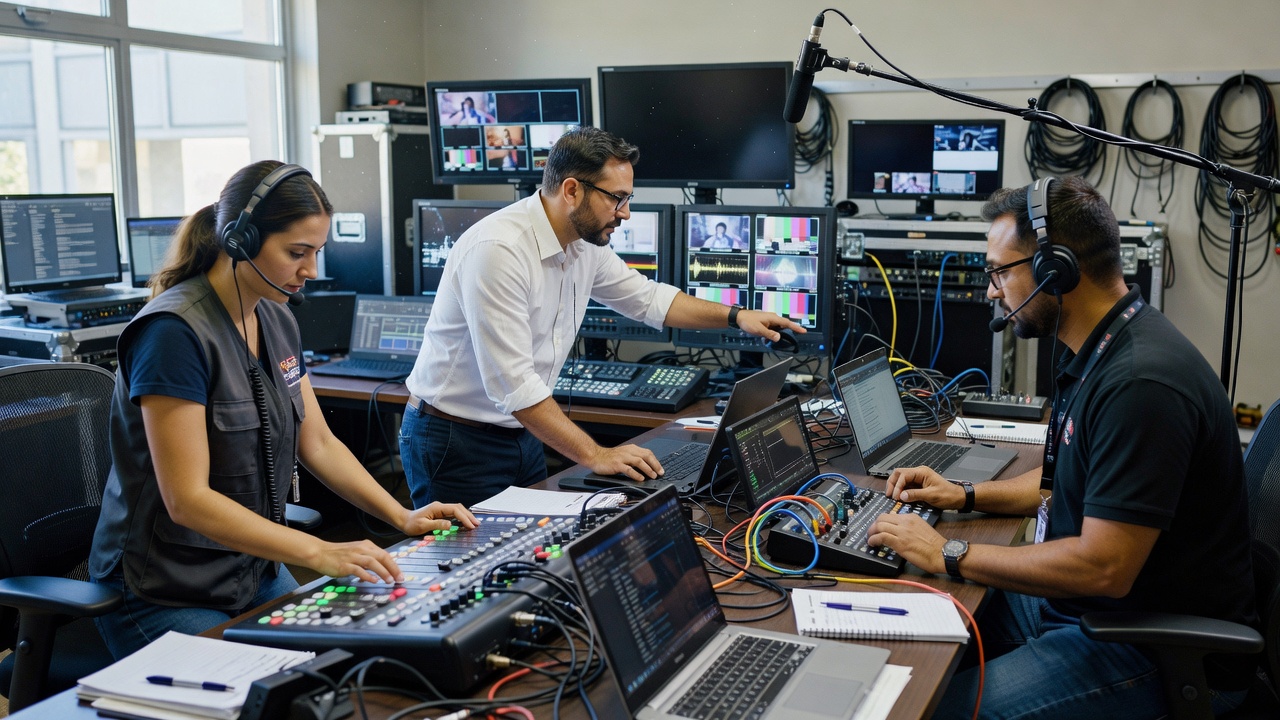
Draw the complete signal path
Map each source from acquisition to its destination. Include observer computers, player cameras, commentary microphones, game audio, graphics, replay, programme output, stream encoding and local recording. Mark conversions, frame rates, resolutions and audio routing. A diagram should show where a source is selected, where it is delayed and which operator can change it during a live match.
Distinguish production networks from contribution and distribution paths. Protocols such as SRT and RTMP solve different transport problems and need suitable configuration; their presence does not establish resilience. If a production uses SMPTE ST 2110 or AES67, clocking, network design and interoperability require specialist attention. Choose a system the available crew can test and support rather than the most elaborate system a budget can rent.
Protect the competition from the programme
Observer accounts may reveal information unavailable to players. Control who can see those feeds, how spectator access is granted and whether the title supports a suitable delay. Confirm the delay requirement with the competition lead and publisher conditions. Do not assume that a streaming platform's ordinary delivery latency provides a consistent or sufficient integrity safeguard.
Check physical information leakage as well. A player may hear commentary, see an audience display or receive an unintended view of another station. Audio isolation, display placement and backstage access all matter. Any protective measure must be assessed under the real room conditions, including an audience and the actual sound system. A quiet rehearsal alone cannot prove isolation.
Build coverage around understandable action
Observers need game knowledge, a coverage plan and a communication route to the director. Discuss priority moments, player naming conventions and how replays will be requested without missing live action. Where several matches run concurrently, state which are fully covered and which receive limited observation. Do not sell comprehensive coverage when the staffing model only supports one match.
Graphics should draw results from an agreed source of truth. Define who verifies a score, who updates it and how a correction reaches all destinations. Avoid letting a manually typed overlay become the unofficial competition record. Prepare name pronunciation notes, team identifiers and approved assets before rehearsal, with a clear route for late roster changes.
Make audio intelligible and controlled
Separate commentary, game sound, venue microphones, communications and programme returns in the routing plan. Check for feedback loops and ensure private crew discussion cannot reach the public mix. Give commentators an appropriate return feed and explain any delay they will hear. Monitor speech intelligibility on ordinary listening equipment, not only studio headphones.
EBU R 128 provides a loudness framework used in broadcasting, but distribution targets depend on the delivery specification. Confirm the receiving platform's current requirements instead of applying a standard without context. Check synchronisation through the complete path: a correctly timed source may become misaligned after conversion, processing or encoding. Record a short test and inspect it independently.
Prepare a reduced-output mode
Define what remains available if the main graphics system, observer source or encoder fails. A clean game feed with intelligible commentary may be preferable to an unstable full production. Prepare holding material, neutral incident wording and a way to communicate estimated updates without promising a repair time the technical team cannot support.
Recording is a separate dependency from streaming. Confirm storage capacity, file naming, access permissions and who checks that files are usable. Keep sensitive player communications out of public recordings unless there is a justified, authorised purpose. Review the rights covering music, game content, camera appearances and redistribution before assuming that every captured source may be published.
End-to-end rehearsal checklist
- Watch the delivered programme from outside the control position.
- Confirm scores and player names against the competition record.
- Test a pause announcement, source loss and return to live play.
- Verify delay, synchronisation and private communications routing.
- Open a recorded test file and confirm usable picture and sound.