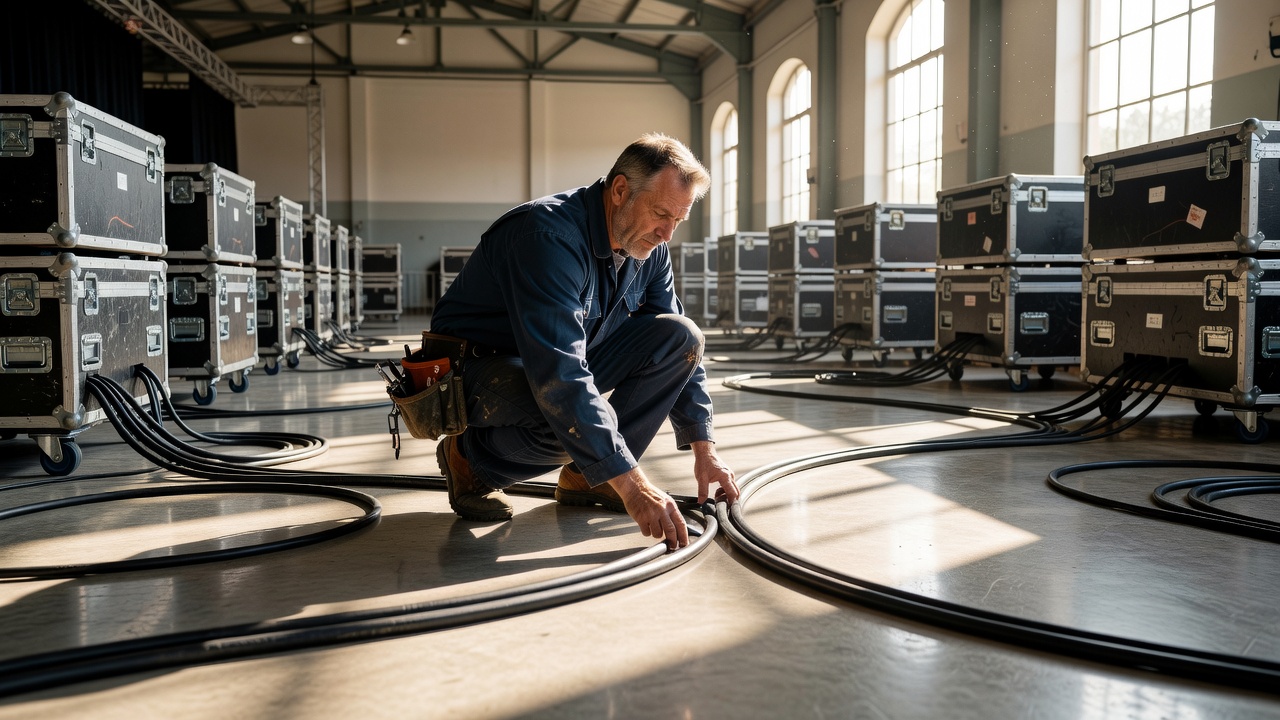
Survey the venue as a working system
Begin with a measured plan showing competition stations, production positions, audience areas, accessible routes, emergency exits and loading access. Add storage, staff welfare and equipment maintenance space. A room that comfortably holds the audience may still fail operationally if every flight case must move through the player call area or if the technical desk blocks an accessible route.
Confirm the venue's permitted activities, access hours, noise restrictions and contractor requirements. Venues such as ExCeL London, Messe Berlin and the RAI Amsterdam illustrate the scale of exhibition infrastructure, but no venue name guarantees the services your event needs. Obtain the actual service specification, local rules and responsible contacts for the specific room and booking.
Treat power as an engineered dependency
Ask qualified electrical personnel to assess connected loads, distribution, protective devices and the proposed installation. Separate circuit labels do not necessarily mean independent supplies. Record which circuits feed player stations, networking, audio and broadcast equipment so that a single fault does not become an unexplained event-wide outage. Do not improvise distribution beyond the competence of the crew.
Assess uninterruptible power supplies against their actual purpose. A UPS might preserve network equipment during a brief interruption, but it does not automatically support every gaming computer or provide a safe continuation strategy. Document expected runtime under realistic load and the action to take before that runtime expires. Follow manufacturer instructions and applicable local electrical requirements.
Test networks against the actual workload
Separate player, production, administration and public access according to the event's security and performance requirements. IEEE 802.3 describes Ethernet technologies, while IEEE 802.1Q supports VLAN-based separation; neither replaces competent configuration, monitoring and access control. A VLAN is not proof that a sensitive system is secure. Document permitted traffic and restrict administration interfaces.
Test with the selected game, authentication services, voice tools, broadcast encoders and expected background activity. Measure latency, packet loss, jitter and upload stability rather than relying on a speed-test headline. Confirm whether the title supports local servers and what still requires internet access. A nominally local match may depend on online authentication, entitlement checks or content delivery.
Where a backup connection is planned, ask whether it shares an upstream provider, physical entry point or local equipment. Test switching under realistic conditions, including any public-address changes that affect sessions. Failover may keep the stream alive while disconnecting a game. Document these differences so that the referee and producer understand what recovery can actually achieve.
Build equivalent player stations
Create a controlled equipment baseline: hardware model, display settings, game build, permitted drivers and approved peripherals. Record accessibility needs early and resolve them without assuming every competitor uses identical inputs. Apply patches through a planned change window. Freeze the accepted configuration when appropriate, but retain a documented response if a security issue or publisher requirement forces an update.
Keep spare devices ready with the same tested configuration. A replacement computer that still needs downloads is inventory, not a recovery measure. Label cables at both ends, maintain a port map and photograph completed stations where useful. Validate cooling, sightlines, chair adjustment and audio isolation during realistic occupancy, not only in an empty room.
Make risk visible before opening
Use a short risk register to connect each failure mode to an owner, a detection method and a response. Prioritise shared dependencies over dramatic but unlikely scenarios. The most valuable test may be discovering that two supposedly separate systems rely on the same unmanaged switch.
| Dependency | Acceptance evidence | Recovery owner |
|---|---|---|
| Player network | Representative concurrent matches complete without unexplained loss | Network lead |
| Power distribution | Qualified assessment and recorded circuit map | Electrical contractor |
| Replacement station | Spare boots, authenticates and joins a test match | Technical support lead |
| Access routes | Approved layout remains usable after full installation | Venue lead |
Release the venue only after unresolved issues have owners and explicit operating decisions. Record any reduced-capacity mode, such as fewer simultaneous stations. The producer must know what that mode does to the schedule before the first player is called.